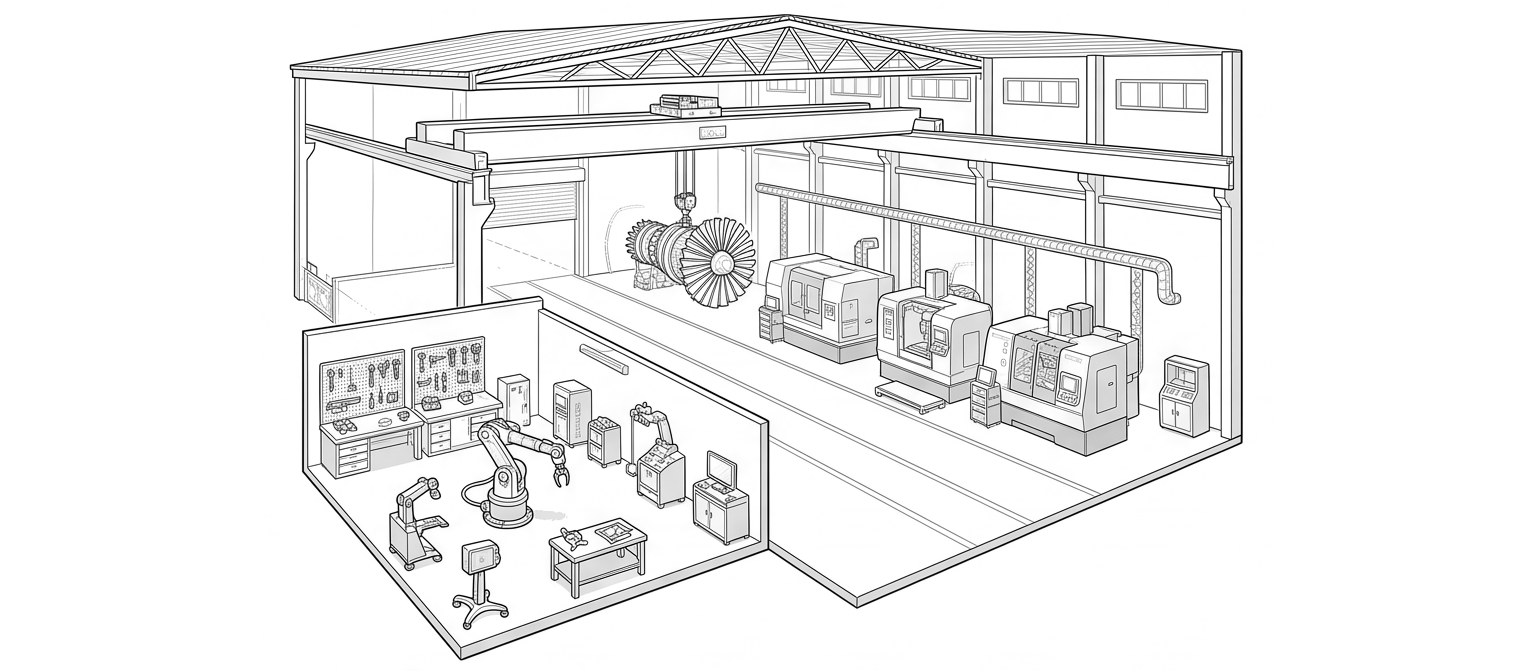
We review asset condition, maintenance criticality, reliability measures and lifecycle expenditure within defined operating boundaries.
Industrial Asset Condition, Reliability & Lifecycle Costing
Our asset-management focus concerns industrial production resources, OPEX management and strategic asset development—not financial portfolio management. We evaluate assets in relation to their operating purpose, condition, maintenance requirements and lifecycle economics. The methods below are industry approaches, not unverified DEKOM performance results.
Industrial Asset Portfolio
Industrial assets can include production facilities, mining fleets, processing machinery, conveyors, warehouses, loading terminals, power-generation equipment and electrical or mechanical infrastructure. Asset registers link each item to its location, function, technical data, criticality and accountable maintenance scope.
Prioritization should consider safety, environmental consequence, production impact, redundancy and replacement lead time. An equipment list does not demonstrate ownership or operating control; actual asset scope requires project-specific confirmation.
Operating Expenditure — OPEX
Direct operating costs typically include labor, electricity, fuel, consumables, spare parts, maintenance materials and process chemicals. Indirect costs can include administration, technical supervision, insurance, facility services, inspection, compliance and operational support. The accounting boundary should avoid double-counting.
Cost-per-tonne analysis needs a defined output measure, time period and allocation basis. Productivity improvements, energy efficiency and maintenance planning should be assessed alongside reliability and safety rather than through cost reduction alone.
Operational budgets should distinguish fixed from variable expenditure and planned from exceptional work. Comparisons need consistent production volume, product mix and utilization; a lower annual spend can result from lower production rather than genuine efficiency.
Maintenance Management
Preventive maintenance schedules work by time or usage. Predictive maintenance uses condition and trend information to anticipate degradation; condition-based work responds to measured thresholds. Corrective maintenance restores function after a fault and may be planned or urgent.
Reliability-centered maintenance selects tasks according to failure modes, consequences and practical effectiveness. Equipment inspection, spare-parts criticality and shutdown planning connect maintenance work with production windows, isolation requirements and contractor access.
Maintenance effectiveness depends on accurate records, competent execution and follow-up. Sensors and software do not themselves prevent failure; measurements need validated thresholds and an actionable response.
Asset Lifecycle Management
The lifecycle starts with identification and registration, followed by condition assessment and maintenance planning. Performance monitoring informs refurbishment, modernization and capital replacement priorities.
Lifecycle cost review combines acquisition, operation, maintenance, downtime and disposal within a stated boundary and time horizon. End-of-life decisions consider safety, remaining service potential, obsolescence, spare-parts availability and environmental obligations.
Digital Asset Management
EAM and CMMS systems can organize asset registers, work orders, maintenance histories, inventory and schedules. Industrial IoT and condition monitoring supply equipment data; predictive analytics can support prioritization when the data quality and model limitations are understood.
Digital records should retain equipment identity, timestamps, measurement context and completed-work evidence. Operational dashboards need defined metrics and clear ownership, so deviations lead to investigation rather than merely presenting attractive charts.
ISO Asset Management Framework
The ISO 55000 family provides an asset-management vocabulary and framework connecting organizational objectives, value, risk and lifecycle decisions. ISO 55001 specifies asset-management system requirements; ISO 55002 provides guidance on applying them.
The framework can inform industrial governance and continuous improvement, but mentioning it does not establish compliance or certification. We make no ISO certification claim without documented evidence.
Industrial performance indicators
- OEE
Availability × Performance × Quality
Use fractions from 0 to 1. Availability = run time / planned production time; performance = ideal cycle time × total count / run time; quality = good count / total count. A consistent output basis is required for continuous processes.
- MTBF
Total operating time / Number of failures
Use the same duration unit and failure definition. With zero failures the observed ratio is undefined; it does not prove infinite reliability.
- MTTR
Total corrective repair time / Number of repairs
Define whether diagnosis, waiting, testing and restoration are included. With zero repairs the ratio is undefined.
- Equipment availability
Available time / Defined assessment time
Define scheduled and unscheduled downtime and the measurement boundary.
- Capacity utilization
Actual output / Defined capacity for the period
Capacity must use the same product mix and time basis as output.
- Maintenance cost per operating hour
Maintenance expenditure / Operating hours
State cost scope and allocation period.
- Energy consumption per tonne
Energy consumed / Tonnes produced
State energy units, output definition and process boundary.
- Production cost per tonne
Allocated production cost / Tonnes produced
Use a consistent cost boundary and output basis.
- Asset lifecycle cost
Acquisition + operation + maintenance + downtime + disposal costs
Discount future costs where appropriate and state the horizon and assumptions.
- Unplanned downtime
Duration of unscheduled loss of required function
Record events and causes consistently; distinguish planned shutdowns.
- Maintenance backlog
Outstanding approved maintenance work
Track estimated work-hours, age and criticality, not only the number of work orders.
These are measurement definitions, not DEKOM operating results. The ISO 55000:2024 framework does not establish our certification. ISO asset-management reference.
Technical and commercial scope
- OPEX Management
- Asset Strategic Development