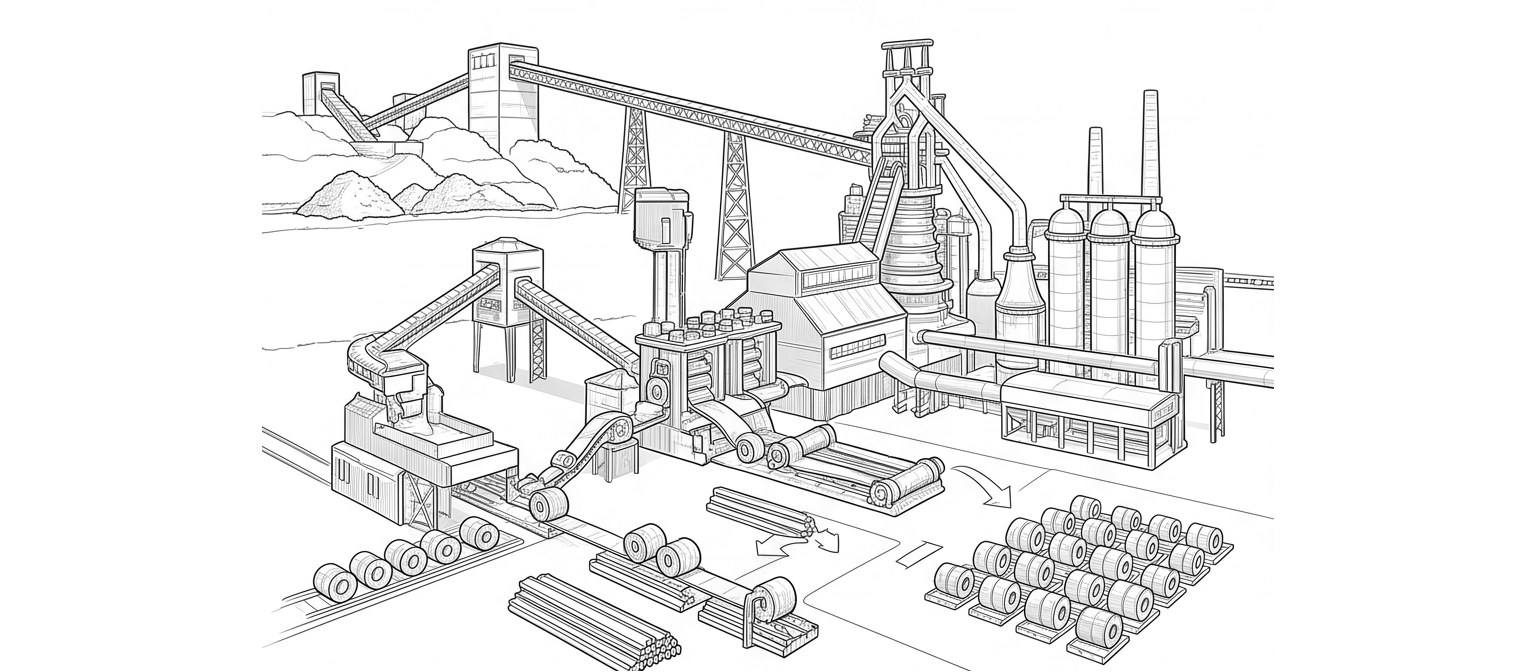
Coal mining and processing form part of our published business activities. Our current asset details remain pending confirmation for publication.
Coal Production, Preparation & Industrial Quality Control
Coal mining and processing form part of our published business activities. We present the principal technical interfaces below to support material and project discussions. Mine locations, reserves, production capacity, equipment ownership and operating results remain unconfirmed for publication.
Geological Assessment and Resource Characterization
Coal evaluation considers seam thickness and continuity, faults, folding, overburden and interburden, coal rank and the variability of quality across a deposit. Exploration results and geological models inform the mining method, dilution risk, selective extraction and expected feed quality.
Proximate analysis addresses moisture, ash, volatile matter and fixed carbon on stated bases; ultimate analysis addresses elemental composition. Resource estimation and mine planning also require appropriate geotechnical and hydrogeological assessment. A geological indication is not a published reserve estimate or proof of an economically recoverable DEKOM resource.
Open-Pit and Underground Mining
Open-pit systems coordinate overburden removal, excavation, loading, haulage and reclamation. Haul-road gradients, drainage, ground conditions and equipment matching influence productivity, fuel consumption and safe traffic separation.
Underground methods include room-and-pillar and longwall systems where geological conditions and mine design permit. Ventilation, ground support, strata control, methane monitoring and dust suppression are essential design and operating considerations. Mine planning must balance extraction sequence, equipment utilization and site-specific safety requirements.
Crushing, Screening and Classification
Run-of-mine preparation reduces oversize material using equipment selected for feed properties and required product size, including roll crushers and, where suitable, jaw crushers. Excessive size reduction can create unwanted fines and should be considered alongside downstream recovery.
Vibrating screens separate commercial fractions and direct material to suitable preparation circuits. Screening efficiency depends on feed distribution, aperture, moisture and near-size particles. Product sizing must be specified by measurable limits rather than descriptive labels alone.
Beneficiation and Fine Coal Recovery
Dense medium baths and cyclones separate coal from denser mineral matter using controlled medium density. Feed size, medium stability, pressure and separator performance affect yield and ash rejection. Jigging uses pulsating water and differences in settling behavior; particle size and density distribution influence its effectiveness.
Fine coal circuits may combine hydrocyclones, flotation and other recovery equipment. Flotation depends on surface properties and reagent conditions, while classification manages the particle-size distribution entering the circuit. Water recirculation, solids control and tailings management are part of the process boundary, not optional afterthoughts.
Dewatering and Product Blending
Dewatering screens, centrifuges and filters reduce surface water according to the fraction and required moisture level. Moisture affects saleable mass, transport economics, freezing or handling behavior and the energy available to a thermal consumer.
Blending can moderate variability and target an agreed specification, but it requires representative component analyses, controlled proportions and confirmation testing. A blend plan alone does not prove that the final shipment satisfies the contract.
Commercial Sizing and Anthracite Classes
Commercial coal may be offered as fines, small, medium or large sized material, screened products or blends. Each description should be accompanied by its size range, oversize and undersize limits and quality basis.
AM, AKO and AS anthracite class names may occur in regional commercial systems. We have not confirmed source-backed size ranges or corresponding quality specifications for publication. No universal range is assigned to those labels on this site.
Handling, Environmental Controls and Safety
Stockpile management considers segregation, residence time, drainage, dust control and spontaneous heating. Monitoring and response depend on the coal’s characteristics, pile geometry and local operating conditions. Conveyor transfers, loaders and discharge points require suitable containment and traffic controls.
Representative sampling, inspection access, moisture management and stockpile homogenization support quality control. Loading and unloading procedures should address exclusion zones, equipment capacity and cargo-specific hazards. The receiving plant and carrier must confirm their applicable requirements.
Coal quality parameters
- Gross Calorific Value (GCV)
Heat released on complete combustion with product water condensed; specify unit and analytical basis.
- Net Calorific Value (NCV)
Available heat with product water remaining vapor; important for delivered-energy comparisons.
- Total Moisture
Overall moisture in the material; affects shipment mass, handling and useful energy.
- Inherent Moisture
Moisture associated with the coal under stated test conditions; distinguish it from surface moisture.
- Ash Content
Residue from prescribed combustion conditions; influences slagging, ash handling and usable combustible fraction.
- Total Sulfur
Sulfur concentration on the stated basis; relevant to emissions control and metallurgical acceptance.
- Volatile Matter
Mass loss excluding moisture under prescribed heating conditions; influences ignition and process suitability.
- Fixed Carbon
Calculated proximate-analysis balance on a consistent basis; not interchangeable with elemental carbon.
- Hardgrove Grindability Index (HGI)
Relative ease of grinding under the prescribed test; relevant to milling-system selection.
- Ash Fusion Temperature
Characteristic ash deformation and melting behavior; used to assess furnace deposition risks.
- Particle Size Distribution
Proportions in defined size fractions; determines handling, screening and application compatibility.
- Bulk Density
Mass per bulk volume under stated conditions; supports storage and transport-capacity planning.
Coal testing reference methods
- Moisture
ISO 11722 / ASTM D7582
ISO 11722 addresses moisture in the general analysis sample; total moisture needs a separate appropriate sampling and test method.
- Ash
ISO 1171 / ASTM D3174
Report the analytical basis and prescribed combustion conditions.
- Total sulfur
ISO 19579 or ISO 334 / ASTM D4239
Select the method suitable for the material and laboratory procedure.
- Gross calorific value
ISO 1928 / ASTM D5865
State units and basis; distinguish measured GCV from calculated NCV.
- Grindability
ISO 5074 / ASTM D409
HGI is a prescribed comparative test, not a plant-specific milling guarantee.
- Particle size
ISO 1953 / ASTM D4749/D4749M
Agree sampling, size limits and oversize/undersize tolerances.
Method families are references, not interchangeable specifications. Confirm the current edition, material scope and laboratory procedure before contracting; editions and revisions can change. ISO catalogue · ASTM International.