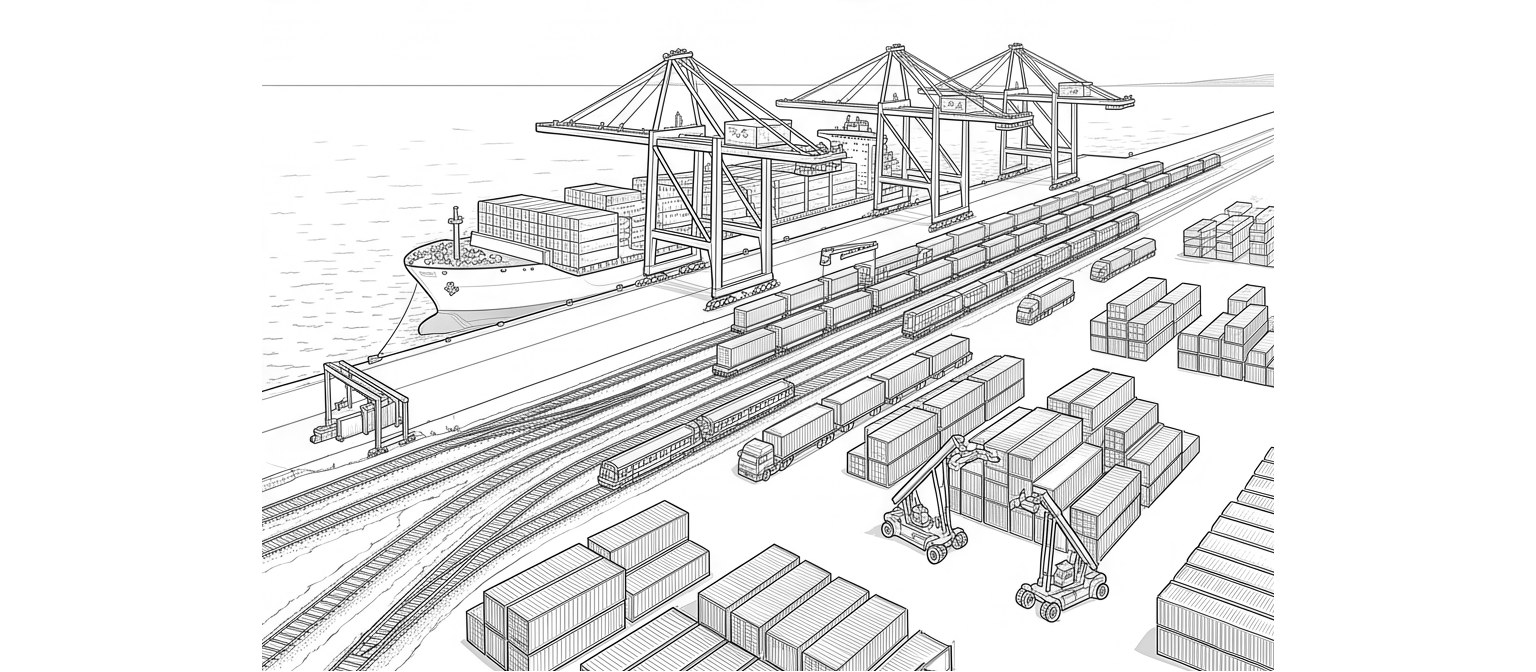
We assess bulk, breakbulk and multimodal transport by cargo properties, port restrictions, handling capacity and agreed cost and risk allocation.
Bulk, Breakbulk & Multimodal Transport Interfaces
We view logistics as the connection between material readiness and industrial delivery. Our logistics discussion covers bulk, breakbulk, container, rail, road and multimodal interfaces. Transport arrangements and responsibilities depend on the transaction; these descriptions do not imply ownership of vessels, ports or transport infrastructure.
International Shipping and Modal Selection
Bulk carriers suit many ore and coal movements, while breakbulk shipping can accommodate steel sections, coils and project cargo. Containers support suitable bagged, packaged and smaller consignments subject to weight, securing and cargo requirements. Rail and road connect the origin and destination with ports or direct industrial users.
Modal selection considers cargo properties, shipment quantity, route availability, transit time, lifting arrangements and the total delivered cost. Multimodal planning must account for each handover and avoid gaps between the responsibilities of carriers, terminals and contractual parties.
Maritime Bulk Cargo Transportation
Handysize, Handymax/Supramax, Ultramax and Panamax are commercial vessel categories, not guarantees of a particular capacity or port suitability. Selection requires confirmation of vessel dimensions, draft, cargo-hold condition, gear where needed and the restrictions at both ports.
Vessel nomination and laycan management align arrival with cargo readiness. Loading and discharge rates depend on terminal equipment, cargo properties, berth access and operational interruptions. Stowage planning addresses stability, distribution, segregation and applicable marine cargo requirements.
Laytime is the contractually permitted loading or discharge time. Demurrage may become payable when allowed time is exceeded under the charter terms; despatch may reward time saved where agreed. Notice of readiness, counting rules and exceptions must be read from the relevant contract rather than assumed.
End-to-End Delivery Process
Contractual planning defines specification, quantity, named delivery place, Incoterm, payment basis and shipment schedule. Origin logistics then coordinates cargo preparation, inland movement, stockyard readiness and export-terminal interfaces.
Quality and quantity control may include representative sampling, laboratory tests, inspection and draft or weight surveys where agreed. Vessel nomination and loading coordinate freight, port agency, readiness and supervision. Voyage communication links shipment documents and estimated arrival with contractual updates.
Destination operations require discharge planning, receiving inspection and customs or inland delivery where contracted. Documentary completion reconciles final shipping records, commercial settlement and claims or adjustments under the agreed procedures.
Shipping Documentation
A bill of lading records receipt and carriage terms and may function as a document of title depending on its form and applicable law. The commercial invoice states the transaction basis. A packing list describes packages and contents where relevant, while a certificate of origin supports origin requirements.
Certificates of analysis and weight report stated tests or quantity methods; they are not interchangeable with independent acceptance. A draft survey estimates bulk cargo mass through vessel displacement calculations and required corrections. Inspection certificates report the scope performed.
Insurance documents evidence the stated cover, subject to exclusions and conditions. Customs declarations support regulatory clearance. Every document should be checked for consistency in parties, cargo description, quantity, dates and references; not every document is required for every shipment.
Logistics Risk Management
Cargo contamination, moisture exposure, physical damage and unsuitable handling can compromise industrial usability. Planning must match holds, packages, lifting attachments, dunnage and discharge equipment to the material. Certain bulk cargoes require specific hazard assessment and documentation under applicable marine rules.
Delay exposure includes vessel availability, congestion, draft restrictions, weather and equipment interruption. Freight and demurrage risks should be reflected in the contract. Documentary discrepancies, sanctions restrictions and customs requirements also need review.
Marine cargo insurance is subject to its insured interests, coverage, exclusions and claims requirements. It does not remove the need for safe handling or resolve contractual liability automatically. Cost allocation and transfer of risk must be assessed separately.
Incoterms® 2020 — Cost, Risk and Responsibilities
We specify the chosen rule, precise named place or port and “Incoterms® 2020” in the agreement. Under CPT, CIP, CFR and CIF, destination carriage cost and earlier risk transfer are separate. The rules do not determine ownership transfer, payment or all contractual remedies.
| Rule / mode | Seller: carriage and cost | Buyer: carriage and cost | Risk transfer | Insurance | Customs clearance |
|---|---|---|---|---|---|
| EXWEx WorksAny mode | Makes goods available at the named place, not loaded. | Loads, arranges and pays collection and all carriage. | At the named place when goods are available to the buyer, before loading. | No obligation to arrange insurance; either party may choose cover. | Buyer: export, transit and import; seller provides required assistance. |
| FCAFree CarrierAny mode | Delivers to the buyer’s carrier at the named point; loads if delivery is at seller’s premises. | Arranges and pays carriage after the delivery point. | At seller’s premises: after loading on collecting transport. Elsewhere: on seller’s vehicle, ready for unloading, at the named delivery point. | No obligation to arrange insurance; either party may choose cover. | Seller: export. Buyer: transit and import. |
| CPTCarriage Paid ToAny mode | Hands goods to the carrier and pays carriage to the named destination. | Bears cargo risk from carrier handover and costs beyond seller-paid carriage. | At handover to the first carrier, unless a different delivery point is agreed; not on arrival at destination. | No obligation to arrange insurance; either party may choose cover. | Seller: export. Buyer: transit and import. |
| CIPCarriage and Insurance Paid ToAny mode | Pays carriage and arranges insurance to the named destination. | Bears cargo risk from carrier handover and costs beyond seller-paid scope. | At handover to the first carrier, unless a different delivery point is agreed; not on arrival at destination. | Seller: Institute Cargo Clauses A or equivalent by default, at least 110% of contract price, subject to agreed variations and policy exclusions. | Seller: export. Buyer: transit and import. |
| DAPDelivered at PlaceAny mode | Arranges and pays transport to the named destination, ready for unloading. | Unloads and arranges import clearance and onward transport. | At the named destination on arriving transport, ready for unloading. | No obligation to arrange insurance; either party may choose cover. | Seller: export and transit. Buyer: import. |
| DPUDelivered at Place UnloadedAny mode | Arranges and pays transport and unloading at the named destination. | Arranges import clearance and onward transport. | After unloading at the named destination. | No obligation to arrange insurance; either party may choose cover. | Seller: export and transit. Buyer: import. |
| DDPDelivered Duty PaidAny mode | Pays delivery to destination and handles applicable clearance, import duties and taxes; ready for unloading. | Unloads; supplies required assistance for clearance. | At the named destination on arriving transport, ready for unloading. | No obligation to arrange insurance; either party may choose cover. | Seller: export, transit and import, including duties and taxes. Confirm seller can legally perform import formalities. |
| FASFree Alongside ShipSea / inland waterway | Delivers alongside the nominated vessel at the named shipment port. | Loads aboard and arranges and pays onward carriage. | When goods are placed alongside the vessel at shipment port. | No obligation to arrange insurance; either party may choose cover. | Seller: export. Buyer: transit and import. |
| FOBFree On BoardSea / inland waterway | Loads goods aboard the nominated vessel at the shipment port. | Arranges and pays main carriage and destination handling. | When goods are on board at the shipment port. | No obligation to arrange insurance; either party may choose cover. | Seller: export. Buyer: transit and import. |
| CFRCost and FreightSea / inland waterway | Loads aboard at shipment port and pays freight to named destination port. | Bears cargo risk from loading aboard; pays costs beyond seller-paid freight. | When goods are on board at shipment port, not at destination. | No obligation to arrange insurance; either party may choose cover. | Seller: export. Buyer: transit and import. |
| CIFCost, Insurance and FreightSea / inland waterway | Loads aboard and pays freight and insurance to named destination port. | Bears cargo risk from loading aboard; pays costs beyond seller-paid scope. | When goods are on board at shipment port, not at destination. | Seller: Institute Cargo Clauses C or equivalent minimum cover by default, at least 110% of contract price, subject to agreed variations and policy exclusions. | Seller: export. Buyer: transit and import. |
Only CIP and CIF impose a seller insurance obligation; other rules do not prohibit insurance. Destination unloading charges under C rules depend on the carriage contract. FCA is generally appropriate where container cargo is handed to a carrier before loading aboard. Source: International Chamber of Commerce.